Cars treated ‘like living room’

Hundreds of people will be killed or seriously injured on WA roads in the next five years because drivers are distracted and treat their cars as an extension of their living rooms, a road safety expert has warned.

A major study by the Monash Injury Research Institute, which analysed 340 serious crashes in Victoria and NSW between 2000 and 2011, found distraction contributed to 16 per cent of crashes.

Though the biggest source of driver distraction was passengers, the paper singled out technology-based distractions such as mobile phones and GPS devices as increasing causes of collisions.

One of the authors, Michael Fitzharris, said the number of “technology distracted” crashes could one day rival the number of accidents as a result of drunk drivers.

“As technology comes into the vehicle more and more and people bring and use it in the vehicle more and more that will, I think, start to become a very significant factor that could well rival intoxication and fatigue,” he said.

Dr Fitzharris said using the data and presuming current rates of distracted collisions stayed constant, at least 238 people would die or be seriously injured on Victorian roads over the next five years as a result of mobile phone use.

“People sometimes see their vehicle as an extension of a living room as opposed to a one and a half tonne piece of metal that goes at 60km/h, and sometimes people don’t fully appreciate the risk as well,” he said.

It was hard to calculate how many on WA roads would fall victim to technology-driven distractions but the issues in the study would probably be the same across the country, Dr Fitzharris said.

According to the WA Road Safety Council, distraction is estimated to play a role in about 30 per cent of fatal and serious accidents in WA.

Examples of distraction include passengers, fatigue, feeling ill, eating and adjusting the car’s sound system or air-conditioning.

The council’s chairman, Murray Lampard, said it would assess the Monash report conclusions for its likely benefits and costs before possibly presenting it to the Government for consideration.

He said developments in technology and in-vehicle improvements could one day save lives.

“It is likely that developments in technology and in-vehicle improvements will provide assistance to the driver to avoid distractions,” Professor Lampard said.


Read more…http://au.news.yahoo.com/thewest/a/-/breaking/17120187/cars-treated-like-living-room/

Motorists driven to distraction by their own devices

Distracted Driving:

More than 1000 people are predicted to die or be seriously injured on Victorian roads in the next five years due to driver distraction from in-vehicle technology such as car stereos, GPS devices or gadgets such as mobile phones.

The economic cost of these predicted collisions has been calculated at $1.285 billion, in a major study of driver distraction by the Monash University Accident Research Centre and Monash Injury Research Institute.

The study analysed 340 serious casualty crashes in Victoria and NSW between 2000 and 2011, using data from the forensic examination of crash scenes and anonymous interviews with drivers. It found that distraction caused 16 per cent of crashes.

While the biggest source of distraction for a driver was a person inside the vehicle, the study’s authors warned that the use of in-vehicle technology, including GPS and mobile phones, was an increasing cause of distraction-related collisions.

Other types of driver inattention, including intoxication, sleep, fatigue and illness, were found to have caused 37 per cent of crashes. The study focused exclusively on crashes caused by inattention in an attempt to know more about why drivers stop concentrating, so did not include collisions caused by speed.

Read more…http://theage.drive.com.au/motorists-driven-to-distraction-by-their-own-devices-20130503-2iyow.html


As part of our Global online driver assessment & mitigation programme we offer Distracted Driving as a training module. Link

More US teens killed texting while driving than drinking

More US teens killed texting while driving than drinking

Texting while driving has now replaced drunk driving as the number one cause of teenage deaths on the road in the US, new research has found.

The study, undertaken by the Cohen Children’s Medical Center in New York, found that more than 300,000 teens are injured and more than 3,000 die each year as a result of sending SMS messages while behind the wheel.

In comparison 282,000 are injured and 2,700 teenagers are killed as a result of drink driving.

Dr Andrew Adesman chief of Developmental and Behavioral Pediatrics at Cohen Children’s Medical Center and the lead author of the study. and a team of Cohen investigators found that between September 2010 and December 2011, among 8,947 teenagers aged 15-18 nationwide, an estimated 49 per cent of boys admitted to texting while driving compared with 45 per cent of girls.

“The reality is kids aren’t drinking seven days per week – they are carrying their phones and texting seven days per week, so you intuitively know this a more common occurrence,” Dr. Andrew Adesman, Chief of Developmental and Behavioral Pediatrics at Cohen Children’s Medical Center and the lead author of the study, told CBS News in New York.

Although it is illegal to text and drive in the UK, in many states in the US it is still allowed.

The news comes as the UK government proposes new fines and penalties to try to stop drivers using their phones in the UK.

Patrick McLoughlin, the UK transport minister, has indicated that fines for a variety of offences will rise by 50 per cent, from £60 to £90 if caught. Users will also be liable for three points on their licence.

Many experts believe that texting or using your phone at the wheel is more dangerous than drink driving because more of us are likely to do it more often as the urge to check our phone can be at any time rather than only when we’ve had a few drinks at a party.

Read …http://www.pocket-lint.com/news/120965-more-us-teens-killed-texting-while-driving-than-drinking 

As art of our global on line driver assessment and training programme UKGRS offer Distracted Driving Modules. Link


Health cash set to fund 20mph bid for key residential areas in Manchester

Health cash set to fund 20mph bid for key residential areas in Manchester

Manchester City Council is set to decide how to make Manchester’s roads safer for children and more attractive for residents by creating more areas of the city with 20 mile per hour speed limits.

The City Council is committed to installing 20mph speed limits on all non-major residential roads across the city, and has identified £500,000 of public health funding to set up the first phase of this project.

The move would not only seek to reduce accidents, but also encourage more cycling and walking in residential areas where cars would be deterred from using streets for short cuts from busy main roads.

Members of the City Council’s executive meeting on May 29 are set to agree how the funding would be used for maximum effect, and they will be asked to support plans for three areas of the city where a 20mph limit will be in force.

The funding – which is enough to cover three parts of the city – would be allocated to areas of greatest need to keep children safe.

National statistics show that a child from a deprived area is five times more likely to be killed or seriously injured from a road accident.

The proposed areas in Manchester are:

Area 1 – Gorton north and Gorton south;


Area 3 – Hulme (east side of A5103 Princess Road), Moss Side and Fallowfield.
Area 2 – Miles Platting, Newton Heath, Ancoats and Clayton;

These areas would complement the existing 138 smaller 20mph zones outside schools and subject to available funds would be the first phase in a move towards setting up a reduced speed limit on all non-major residential roads across the city.

Councillor Bernard Priest, Manchester City Council’s executive member for neighbourhood services, said: “We already have locations across the city where motorists are required to drive at 20 miles per hour to protect children and other pedestrians as well as cyclists.

“Projects like this have been popular with schools and parents, and have helped to reduce accidents, both here and in other parts of the country. We’ve committed to setting up a 20 mph speed limit on residential roads across the city and the first phase of that is due to start in the next few months when we set up three large areas of the city where this will be in force.”

If members agree to the proposals, a public consultation will be held before the new 20mph areas are created.

Traffic surveys would also be carried out before and after the introduction of the zones to monitor results.


Read more… http://www.manchester.gov.uk/news/article/6588/health_cash_set_to_fund_20mph

New report: combat road death ‘plague on young’ in Post-2015 Goals

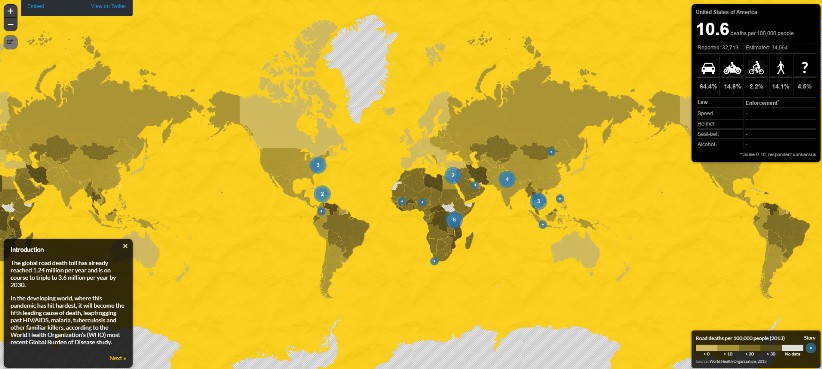
Road traffic fatalities have become a plague on the young and the world must commit to reduce the global death toll by half by 2030 as part of the post-2015 sustainable development agenda, according to a new report published on 7 May from the Commission for Global Road Safety.

Alongside the report’s release ‘The Long Short Walk’, a new worldwide social media campaign, was launched. Around the world, groups and members of the public are taking part in walk events, sharing their photos and videos calling for road safety to be included in the post-2015 agenda. The Long Short Walk is being led by the Make Roads Safe campaign together with the family of Nelson Mandela, whose great-granddaughter Zenani Mandela was killed in a road crash aged 13.

Globally, road injury has become a severe health burden for young people – and particularly for young men. It is the number one cause of death for young people aged 15-29 and the second biggest killer of men aged 30-40 after HIV/AIDS. Public health and international development donors must follow the evidence of the recent Global Burden of Disease 2010 study and include road traffic injury within their financial and technical assistance portfolios, the report recommends.

The Make Roads Safe report, ‘Safe Roads for All: a post-2015 agenda for health and development’ calls for road traffic injury prevention to be included in the post-2015 Sustainable Development Goals, the mainstream of international efforts to improve global health, combat climate change and tackle inequality and poverty. Road injury is one connecting symptom of all these 21st century challenges, according to the Commission.


Read More…http://www.makeroadssafe.org/news/2013/Pages/MakeRoadsSafereportcombatroadtrafficinjury%E2%80%98plagueonyoung%E2%80%99inPost-2015Goals.aspx

Road safety in Vietnam

Road safety in Vietnam:

You could be the safest driver in the world, but that does not mean someone else will not do the wrong thing. In a split second everything can change, with the most terrible of consequences. Thousands of people are killed and seriously injured on the roads in Vietnam each year. Brett Davis and Chris Mueller talk to some of those who have endured the pain and loss caused by traffic accidents, and look at how you can avoid becoming another statistic. Photos by Fred Wissink.


Read More… http://www.asialifemagazine.com/vietnam/road-safety-in-vietnam/


UK Global Road Safety: Offer as part of the global online driver assessment & training programme a Two Wheel – Link


Drink driving rules tightened to improve road safety

Release Date: 02/05/2013

The most dangerous drink drivers will now have to pass a medical before they are allowed back on the roads under a change in the law announced today by Road Safety Minister Stephen Hammond.

The changes, which come into force from 1 June 2013, mean that High Risk Offenders will need to pass a medical confirming they are no longer alcohol dependent at the end of their disqualification and before they start driving.

Currently, all High Risk Offenders must pass a medical examination before they can be issued with a driving licence following their disqualification. However, drivers can start driving as soon as they have applied for their driving licence. Evidence suggests that some High Risk Offenders delay their medical in order to continue driving. The changes will prevent High Risk Offenders from driving until they have passed their medical examination and been granted a licence.

The changes also mean that drink drivers who refuse to give permission for a blood sample to be analysed will now be High Risk Offenders. This means that they will only get their licence back following disqualification if they pass the required medical.

Road Safety Minister, Stephen Hammond said:

“Drink drivers are a menace and it is right that we do everything we can to keep the most high risk offenders off the road.

“These changes will tighten up the law on drink driving and will mean that the most dangerous offenders will have to prove they are no longer dependent on alcohol before they are allowed to get back behind the wheel.

“The new measures will also see those drink drivers who obstruct the police by refusing to allow their blood samples to be analysed treated the same as other high risk offenders.”


Read More…http://www.dft.gov.uk/dvla/pressoffice/pressreleases/02052013.aspx

‘Dutch roundabouts’ could be seen in London next year

Roundabouts like the ones used in the Netherlands separating cars from cyclists could be used in London as early as next year, the city’s cycling commissioner has said.

Trials of the layout are taking place at a research laboratory in Berkshire.

The roundabouts do not conform with Department for Transport regulations as they stand.

But Andrew Gilligan said if the trials continued to go well they could be seen in 2014.

‘Fantastic for cyclists’

The layout gives cyclists priority and means they are in the line of sight of drivers when vehicles exit the roundabout.

Transport for London is testing traffic signals for cyclists

Campaigners have called for a number of London junctions to be changed to make them safer following cyclists’ deaths.

In 2011 two cyclists died in the space of three weeks at the Bow roundabout in east London.

The roundabout trial, which has been going for six weeks and will end in July, forms part of the mayor of London’s Vision for Cycling.

Read BBC Report…http://www.bbc.co.uk/news/uk-england-london-22347184

Motorway of the future plans include glowing heat gauges

While car makers have raced to add the latest technologies to their vehicles, the roads they drive on have arguably failed to evolve at the same pace.

Now, an odd couple based in the Netherlands hope to change that with visions of self-illuminating weather warning signs painted on to the tarmac, and a dedicated lane capable of recharging electric cars on the go.

The pair are Daan Roosegaarde, an artist famous for wacky interactive projects, and Hans Goris, a manager at the Dutch civil engineering firm Heijmans.

Mr Roosegaarde’s past efforts have included a dance floor with built-in disco lights powered by dancers’ foot movements, and a dress that becomes see-through when the wearer is aroused.

Heijmans spends much of its time working on more sober schemes, such as city centre car parks and shopping centres.

Mr Roosegaarde (left) and Mr Goris (right) will test their paints on a 450ft (137m) stretch of road later this year

As unlikely as the pairing sounds, the two men believe their smart highway concept has the potential to revolutionise motorways.

Read BBC Report …http://www.bbc.co.uk/news/technology-22354675

Potholes form top priority for local councillors

Local councillors have said improving road surfaces and reducing potholes is a top road safety priority, although the majority think that budgets for repairs will decrease or stay the same.

These are some of the findings in a survey conducted by a road safety charity.

The organisation’s research found that 74% of councillors placed potholes in their top five road-safety priorities while 61% think that the budgets for repairing them will decrease or stay the same.

Almost half of councillors surveyed think that road safety targets should have been kept. A total of 58% of local councillors agree that budget cuts are having a negative impact on roads and road safety, with one in four councillors strongly agreeing.

Although councillors agreed that transport was a priority half of them thought that their transport budget would reduce in the next year.

Other key findings include:

  • 59% of councillors support 20mph speed limits, with 15% supporting 20mph for most urban roads.
  • 29% of councillors think that the government’s policies have been bad for road safety.
  • Councillors in the north of England are more likely to say they anticipate spending reductions while councillors in the south and east of England are less likely to report reductions in their transport budgets.


Green Fleet Driver training Company of the Year Award 2012 – UKGRS Commended